What Is Product Design? The Discipline in 2026 and beyond
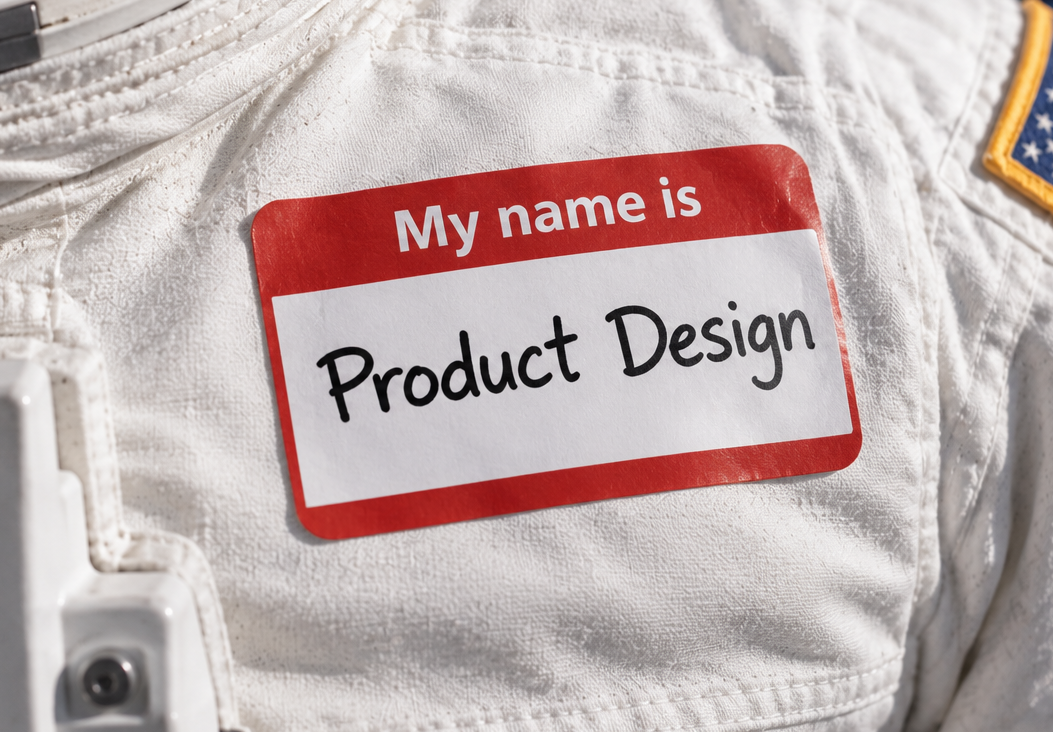
What Is Product Design? The Discipline in 2026 and beyond
In 2023, the user experience pioneer Jakob Nielsen surveyed 458 practitioners about what this field should call itself. "User experience" won with 64%. "Product design" got 8%.
Three years later, a widely followed job tracker counted 52,350 open US roles across the discipline and found product design accounted for 16,400 of them — roughly 31% — while "UX design" no longer existed as a category at all. It had been folded in.
Product design won the market and lost the vote. The reason has almost nothing to do with what most executives think designers do.
What is product design?
Product design is the practice of deciding what a product should be, and then making it real. It is problem framing, research, information architecture, interaction and interface design, systems work, and increasingly the code that ships.
The distinction from UX design is one of scope rather than craft. As the Interaction Design Foundation frames it, UX design concentrates on usability, accessibility and the quality of interaction. Product design adds more: market viability, roadmap ownership and accountability for whether the thing succeeds commercially. A UX designer asks whether the user can complete the task. A product designer goes further, with the expectation to argue about whether a task should exist.
To be fair, this is an aspirational definition. The actual postings are narrower. An analysis of 58 live product designer listings in July 2026 found the most common requirements were design systems fluency (76%) and end-to-end ownership (67%), with AI tools named in 67% and AI fluency required outright in 38%. Business-outcome language barely registered. Of the 53 postings that stated an experience minimum, none were entry-level.
The collision with product management
There's an awkward problem with that aspirational definition, oddly skipped by most write-ups on the topic. Many of these terms, such as market viability, roadmap ownership and commercial accountability, etcetera: these are the product manager's job description. Two disciplines laying claim to the same territory. Who's winning? The same July 2026 tracker that counted 16,400 open product design roles counted 31,900 in product management — nearly twice as many. TrueUp data cited by Fast Company shows PM demand overtaking design demand in mid-2023 and the gap widening since.
The irony is that the title itself came from PM-led teams. As Budd notes, "product designer" was popularized by the small cross-functional squads that product managers ran in US startups. Design inherited a broader name from the structure that had just claimed the strategy.
Now, AI has turned the overlap into an open contest. Fast Company characterized it as a "three-way standoff" between designers, engineers and PMs, each newly able to do a passable version of the others' work. Marc Andreessen's summary: "AI is actually now a really good coder, a really good designer, and a really good product manager." ChatPRD founder Claire Vo put the threat to designers more sharply: "If a PM or engineer can get 85% there with tailwind and a dream, you better come to the table with more than 'I represent the user.'" Anthropic design chief Joel Lewenstein is more sanguine — "it's like a Venn diagram that's coming closer together," with clear swim lanes still underneath.
This goes both directions, and survey data shows it. Designer Fund [2026 Study] (https://stateofaidesign.com/) found that 65% of designers take on more product or engineering responsibilities, while 40% say product managers and engineers do more design work. The costs are unclear: 34% say collaboration has become more chaotic and ownership more unclear. The share of those reporting "decreased" collaboration jumped from 5% to 20% within a year. At Stripe, an internal AI prototyping tool that turns specs into workable processes constrained by design systems, was adopted by product managers faster than by designers (https://rogerwong.me/2026/05/stripe-protodash-ai-prototyping),
The traffic runs both ways, and the survey data shows it. Designer Fund's 2026 research found 65% of designers taking on more product or engineering responsibilities — while 40% reported PMs and engineers doing more design work. The cost shows up as ambiguity: 34% said collaboration had become messier with less clear ownership, and the share reporting decreased collaboration jumped from 5% to 20% in a year. At Stripe, an internal AI prototyping tool that turns specs into working, design-system-constrained flows was adopted faster by product managers than by designers, who paste in a PRD and generate the flow before design is involved.
Evidence does not show a surge in companies handing PM jobs to designers. The pattern seems to be more convergence than substitution. The "product builder" framing, and Designer Fund's finding that when leaders were asked which role is essential and didn't say product designer, 72% named design engineer instead. So the title promises strategy, the market buys systems work and autonomy, and the strategy itself is contested by a role with twice the open headcount. That leaves a tension explained below.
How UX design became product design
Don Norman took the "User Experience Architect" job title at Apple in 1993, and he has since been careful to share the credit with colleagues Tom Erickson and Harry Saddler. He complained in later years that the term had spread so far and wide it was losing meaning.
The substitution began in Silicon Valley around 2012 and was named in 2016, when Clearleft founder Andy Budd published "The Industrialisation of Design (or why Silicon Valley no longer hires UX designers)". His argument was structural, not cosmetic: dedicated researchers absorbed the research, product managers absorbed the strategy, and design systems meant interfaces "can now be assembled from their component parts." What was left — UI craft plus enough UX literacy to be dangerous — got a new name. "Product designers," Budd wrote, "have become the new interaction designers."
Budd later added the geographic detail that still holds. "Product designer" dominated US startups; "UX/UI designer" persisted in European agencies and institutions. UK job data bears this out: over the six months to September 2026, ITJobsWatch logged 240 UK postings for UX designer against 86 for product designer — roughly the inverse of the American picture.
The renaming has not stopped. In March 2025 Duolingo rebranded its UX org to "Product Experience." Nielsen's objection to that whole habit is the sharpest counter-argument in the field: ten names in forty years, a terminology half-life under a decade, and a discipline that "constantly reinvents the wheel, which keeps us from iteratively refining."
The misunderstanding: why "pixel pushing" is expensive
Ask a non-designer what a product designer (or UX) does and you will usually get an answer about screens. It is a misunderstanding with a well-documented cost.
Peter Merholz, co-author of Org Design for Design Orgs, identified the mechanism: under often badly implemented Agile, "design becomes a factory for producing pixel widgets to feed the machine" and "isn't able to contribute to the upfront strategy thinking that they might've been able to influence before." This is because designers are sent into the fray, after decisions are made and then asked to render those decisions.
The profession's own answer to this failing was "design thinking." It has collapsed as a brand, though. IDEO, somwewhat of a commercial standard-bearer, cut roughly a third of its headcount across 2023 and closed offices in Munich and Tokyo. MIT Technology Review's retrospective documented flagship projects that won awards and changed nothing: "Execution has always been the sticky wicket for design thinking." By 2025, an analysis of 176,000 design job listings found mentions of "design thinking" down 17.6% year over year in product design roles and down 57.2% in graphic design.
Here is the part the design industry does not like to say out loud. Its economic case rests on a 2018 McKinsey study of 300 companies which found top-quartile performers on its Design Index posted 32 percentage points higher revenue growth and 56 points higher shareholder returns. McKinsey described the finding as correlation, explicitly. A methodological critique by human-factors principal Charles Mauro and Columbia statistician Paul Thurman noted there was "virtually no indication that the sample of companies were representative." Eight years on, there has been no flagship follow-up. A profession that asks to be judged on outcomes has been citing a single correlational study for most of a decade.
McKinsey's own 2021 follow-on work found only 10% of respondents believed they were realising design's full potential, 20% used quantitative design measures in performance reviews, and 5% tied design metrics to compensation. If design is not measured, it will be read as decoration.
There is one place where "more than layout" has teeth. The European Accessibility Act applied from 28 June 2025, covering e-commerce, consumer banking, e-books, transport services and consumer hardware — and it reaches any provider serving EU consumers, wherever it is based. Accessibility is now a legal property of an interface, not a nice-to-have. It is also, as we will see, the thing AI-generated UI is worst at.
The job market: contraction, then a reshaping
The numbers are ugly and then they are complicated.
Indeed's own UX team measured the crash: from a Q1 2022 peak to Q2 2023, UX research listings fell 71% and UX design listings 70%, both ending below their 2021 baseline. Time-to-hire roughly doubled in difficulty — 67.9% of designers landed a role within three months in 2019, against 49.5% in 2024.
But the same dataset, tracking 640,000 design professionals, found UX-titled roles up 29.2% since 2019. The US Bureau of Labor Statistics — which, tellingly, has no occupation called "UX designer" or "product designer" — projects 6% growth for web and digital interface designers from 2025 to 2035, with a median wage of $104,000. Nielsen Norman Group's State of UX 2026 reports senior and generalist roles recovering faster than entry-level ones.
It is also worth being precise about what AI has and has not been shown to do here. Stanford's "Canaries in the Coal Mine" study — 3.5 million-plus US payroll records a month — found employment for 22-to-25-year-olds in the most AI-exposed occupations now sits 19% below its counterfactual, driven by reduced hiring rather than layoffs. Design is not among the occupations it names. Anyone citing it as proof that AI is eliminating designers is extrapolating.
NN/g's verdict on where the risk actually lies is blunter than any statistic: "If you're just slapping together components from a design system, you're already replaceable by AI."
How the work happens now, and what happened to the tools
The handoff is disappearing, and with it the category of tool built to serve it.
Figma's arc tells the story. Dev Mode and Code Connect made the spec-and-redline ritual largely redundant. Config 2025 shipped Figma Make (prompt-to-working-prototype), Sites, Buzz and Draw. Config 2026 went further, putting Code Layers — live code as a layer type on the canvas — into beta alongside Figma Motion and a canvas-aware Figma Agent that connects to external tools over MCP. Figma's framing: "Code is material, just like images, vectors and design layers." Commercially it is working — Q2 FY2026 revenue of $370.1M, up 48%, with net dollar retention of 136% and more than 80% of customers above $10K ARR consuming AI credits weekly.
Zeplin, the tool most identified with classic handoff, did not die — it moved. It is independent and shipping, having repositioned around the layer Figma captures less well: annotation, documentation, approval workflow and accessibility metadata. In February 2026 it launched an MCP server exposing specs, annotations and design tokens directly to coding agents. Its AI design review left beta in June. That is the shape of the whole tooling market: whatever can be reduced to geometry gets commoditised, and the surviving value is in encoded intent.
Which brings us to the most consequential shift in how design works today: the design system has become the interface between design and AI.
The plumbing is now real. The Design Tokens Community Group reached its first stable specification in October 2025 (a community spec, not a W3C standard — a distinction most coverage gets wrong). Figma's MCP server went generally available with design-system guidelines support; Code Connect maps components to their real code equivalents so an agent composes from your library instead of inventing a new button. Brad Frost draws the line precisely: this is "what distinguishes DS+AI from vibe coding; the AI is deliberately constrained to using the high-quality design system materials." Indeed's Diana Wolosin puts it more bluntly: "AI is a new user."
Meanwhile the prompt-to-UI market has become genuinely large — Lovable raised $400M at a $13.3B valuation in August 2026 on roughly $500M annualised revenue — and the incumbents have company. Anthropic's Claude Design, launched April 2026, builds a design system by reading your codebase and hands off to Claude Code.
What the evidence says about AI-generated design
Adoption is not in doubt. Designer Fund and Foundation Capital's AI in Design 2026 survey of 900+ designers found 91% using AI weekly (up from 54% a year earlier), half have shipped AI-generated code to production, and 43% say their employer now expects working prototypes as deliverables. Notion designer Brian Lovin's summary of his own workflow: "I haven't written a single line of front-end code in 3 months." (Both sources have an interest in the conclusion — one is investor-produced, the other a practitioner profile.)
Quality is a different question, and the honest answer is that the record is mixed and the strongest negative evidence is about accessibility.
WebAIM's 2026 Million report found detectable WCAG failures on 95.9% of the top million home pages, up from 94.8%, with errors per page rising 10.1% — reversing years of improvement. WebAIM attributes this partly to "increased reliance on 3rd party frameworks and libraries and automated or AI-assisted coding practices ('vibe coding')." A W4A 2025 study of 80 LLM-generated interfaces found a 58% expert-assessed violation rate from a naive prompt — falling to 19% when the prompt specified WCAG criteria. The accessibility knowledge is the intervention.
On code: GitClear's analysis of 623 million changes found block duplication up 81% since 2023 while refactoring collapsed (the vendor sells code analytics; the finding is correlational). Google's 2025 DORA report reversed its prior year and found AI positively associated with throughput — but still negatively associated with delivery stability. Its conclusion is the best one-line summary available: "AI doesn't fix a team; it amplifies what's already there."
And the most-cited skeptical number deserves its footnote. METR's randomised trial found experienced open-source developers were 19% slower with AI while believing they were 20% faster. In February 2026 METR revised its own design, conceding the method now biases against AI and yields "only very weak evidence." Cite it, but cite the correction too.
The deepest risk may not be quality at all but sameness. Doshi and Hauser's Science Advances study of 293 writers found generative AI raised individual creativity roughly 7% while making outputs measurably more similar to each other — "an increase in individual creativity at the risk of losing collective novelty." That study is about short stories, not interfaces. But if you have looked at ten AI-assisted SaaS dashboards lately, you already have the intuition.
Where this goes
Three shifts are worth planning around.
The deliverable is changing from artefact to context. NN/g now argues the output of research and design is "context that anyone in the organization can include when using AI to generate anything" — and that "there is no handoff." Design systems, tokens, annotations and documented rationale become the product of design work, because they are what the agents read.
Judgment is the constraint, not production. Linear's Karri Saarinen: "The hard part of design is rarely generating the form. It is understanding the problem well enough to know what and how something should exist at all." He is openly skeptical of collapsing design into code — "my worry isn't the code or the tools themselves. It's a decline in consideration." Julie Zhuo complicates the comfortable version of this argument: if taste is pattern recognition plus social validation, she suspects AI can replicate it, and what stays scarce is the will to act on your own values.
The interface itself is in play. NN/g's flat statement is that "the interface is becoming less central." OpenAI paid $6.5 billion for Jony Ive's io in 2025 to build a pocket-sized, screen-free device — now delayed to 2027. Designers whose expertise is bounded by the screen are betting on a narrowing surface.
The organisational failure to watch is not technological. Designer Fund found 73% of designers reporting higher expectations on output and speed, while only 28% of leaders had formally updated evaluation practices, 8% changed performance metrics, and 4% adjusted compensation. Firms are collecting the productivity and have not decided what they are now paying for.
Which returns us to where we started. The rename from UX to product design was an attempt to claim a wider remit. Whether that claim was ever honoured depends entirely on whether the organisation lets design set intent or only render it. AI has made rendering nearly free. It has made intent the whole job.
Sources
- UX Vocabulary Inflation — Jakob Nielsen, Oct 2023
- UX Job Market Update: July 2026 — AcademyUX, Aug 2026
- Where did the term User Experience (UX) come from? — Don Norman, Apr 2023
- The Industrialisation of Design — Andy Budd, Feb 2016
- The Historical Context of UX, UI, and Product Design — Andy Budd, UX Magazine, Dec 2024
- What 58 Product Designer Job Postings Reveal — Emily Backes, Jul 2026
- Did Duolingo kill UX design? — LogRocket, Mar 2025
- Why are designers, engineers, and product managers in a 'three-way standoff'? — Fast Company, Apr 2026
- The internal AI tool that's transforming how Stripe designs products — Roger Wong, May 2026
- Peter Merholz on design and Agile — Aug 2020
- Design giant Ideo cuts a third of staff — Fast Company, Nov 2023
- Design thinking was supposed to fix the world — MIT Technology Review, Feb 2023
- 'Design thinking' is on its deathbed — Fast Company, Jul 2025
- The Business Value of Design — McKinsey, Oct 2018
- Critical Analysis of McKinsey's Business Value of Design — Mauro & Thurman, Jan 2019
- Made to measure: Getting design leadership metrics right — McKinsey, Mar 2021
- Directive (EU) 2019/882 — European Accessibility Act
- UX Design and UX Research Job Listings Plunged in 2023 — Indeed Design, Aug 2023
- State of the design job market — Chris Abad, ADPList, Oct 2024
- Web Developers and Digital Designers — US BLS, Aug 2026
- State of UX 2026 — Nielsen Norman Group, Jan 2026
- Canaries in the Coal Mine? — Brynjolfsson, Chandar & Chen, Stanford, rev. Aug 2026
- Config 2025 recap and Config 2026 recap — Figma
- Figma Q2 2026 results — Aug 2026
- Zeplin MCP server — Feb 2026
- Design Tokens specification reaches first stable version — DTCG, Oct 2025
- Agentic Design Systems in 2026 — Brad Frost, Dec 2025
- Agentic Design Systems: The Complete Guide — Into Design Systems, 2026
- Lovable confirms new $13.3B valuation — TechCrunch, Aug 2026
- Introducing Claude Design — Anthropic, Apr 2026
- AI in Design Report 2026 — Designer Fund & Foundation Capital, May 2026
- How Notion's design team uses Claude Code to prototype — Lenny's Newsletter, Feb 2026
- The WebAIM Million 2026 — WebAIM, Feb 2026
- When LLM-Generated Code Perpetuates UI Accessibility Barriers — Guriță & Vatavu, W4A 2025
- The Maintainability Gap — GitClear, Jan 2026
- 2025 DORA Report — Google Cloud, Sep 2025
- Measuring the Impact of Early-2025 AI on Experienced Developer Productivity and design revision — METR
- Generative AI enhances individual creativity but reduces collective diversity — Doshi & Hauser, Science Advances
- UX-Context Design — Tony Alicea, NN/g, Jul 2026
- Design is more than code — Karri Saarinen, Linear, Dec 2025
- When AI Has Better Taste Than You — Julie Zhuo, Jun 2025
- OpenAI's Jony Ive device delayed to 2027 — MacRumors, Feb 2026